What is ausbildung in germany
Ausbildung is the name Germany gives to its official dual vocational training system — a structured path where trainees earn a wage while working inside a real company and, at the same time, attend a vocational school for the theory side of their trade. Programs run for roughly 2 to 3.5 years and lead to a nationally recognized qualification in one of Germany’s hundreds of officially registered trades. Pay is set by law contracts beginning in 2026 must start at minimum of €724 per month in year one, climbing past €1,000 by year four. Both German nationals and international candidates can apply, which makes Ausbildung one of country’s most reliable routes into skilled career.
What Does “Ausbildung” Actually Mean?
Literally, Ausbildung just means “training” or “formation” in German. But when Germans use the word in a career context, they mean something very specific: a regulated apprenticeship in which a trainee — known as an Azubi, from Auszubildende/r — learns a profession through paid work experience alongside structured classroom study.
What separates it from a casual internship is the legal framework behind it. Every Ausbildung program is governed by Berufsbildungsgesetz (BBiG), Germany’s Vocational federal Training Act. That law forces every training program to follow an approved curriculum, requires signed apprenticeship contract, sets legal wage floor and finishes with a certification exam run by an official Chamber IHK Chamber of Industry and Commerce for most commercial and industrial trades, or the HWK (Chamber of Crafts) for handwerk professions.
Germany recognizes currently over 320 distinct Ausbildung trades, ranging from healthcare and software development to construction, hospitality and classic craftsmanship. You can read more about how this compares to Germany’s parallel dual study programs, which blend a bachelor’s degree with the same kind of company-based training.
How the Dual Training Model Actually Works
The system is called “dual” because trainees learn in two places at once company for hands on practice and a vocational school (Berufsschule) for theory. Neither half is optional and both run side by side for entire length of the apprenticeship.
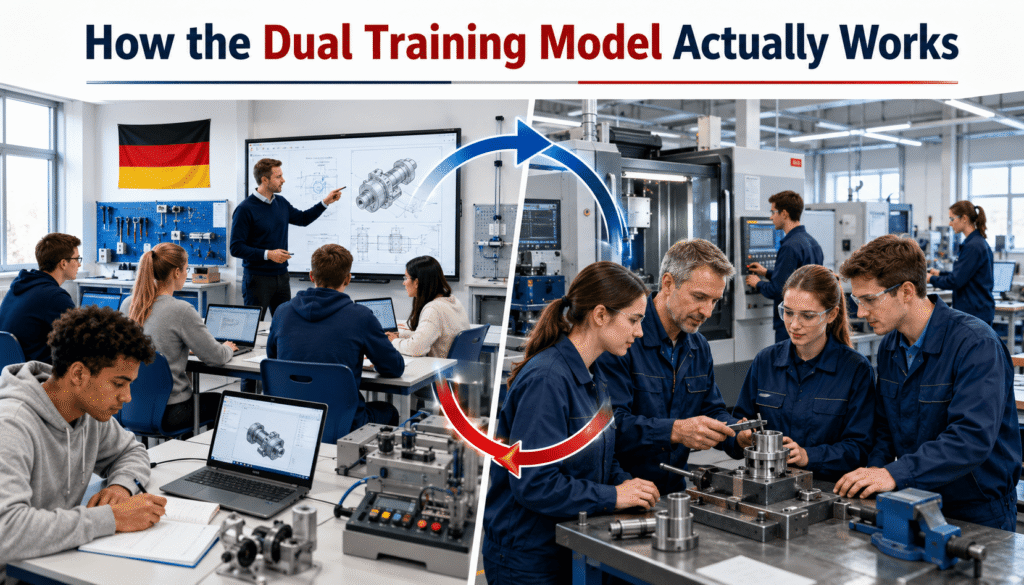
In practice typical week or training cycle looks like this:
- Workplace training: The Azubi is genuine employee under signed training contract (Ausbildungsvertrag), completing real tasks under supervisor’s guidance and taking on more independence as program progresses.
- Vocational school: Classroom time covers trade specific theory plus broader subjects such as German language, business studies and civics.
- Length of training: Most apprenticeships run 2 to 3.5 years, strong though prior academic results can sometimes shorten timeline.
- Certification: The program wraps up with standardized Chamber exam; passing it hands the trainee qualification that’s recognized nationwide, not just by the training company.
This structure is a big part of why Germany consistently posts some of the lowest youth unemployment figures in the EU — graduates leave with skills that have already been tested in a real workplace, not just on paper.
Which Ausbildung Fields Can You Choose From?
Ausbildung trades cluster into a handful of broad categories — technical/industrial, healthcare, IT, office and commercial roles, retail and hospitality, and traditional craft trades (Handwerk). Frequently chosen paths include IT specialist, nursing, mechatronics technician, office assistant management and hotel specialist.
Some of most in demand categories:
- Technical & Engineering: Mechatronics technician, electronics technician, mechanic industrial
- IT & Digital: IT specialist (app development or systems integration track), IT support technician
- Healthcare: Nursing specialist (Pflegefachmann/-frau), medical assistant (MFA), dental assistant
- Office & Commercial: Office management assistant, industrial clerk, wholesale/export trade clerk
- Retail & Hospitality: Salesperson retail, hotel specialist, restaurant specialist
- Handwerk Skilled Crafts: Carpenter, electrician, hairdresser, baker, plumber
Every trade follows federally approved training framework (Ausbildungsrahmenplan), so content of, say, Mechatronics Technician program stays consistent whether it completed in small workshop in Bavaria or a large manufacturer in North Rhine Westphalia.
How Much Does an Ausbildung Pay in 2026 ?
Apprentices receive a monthly training wage Ausbildungsvergütung for whole program. The legally guaranteed floor for starting contracts in 2026 is €724 in first year and it climbs automatically each following year. Many trainees are paid above noticeably that floor, particularly in sectors covered by union agreements.
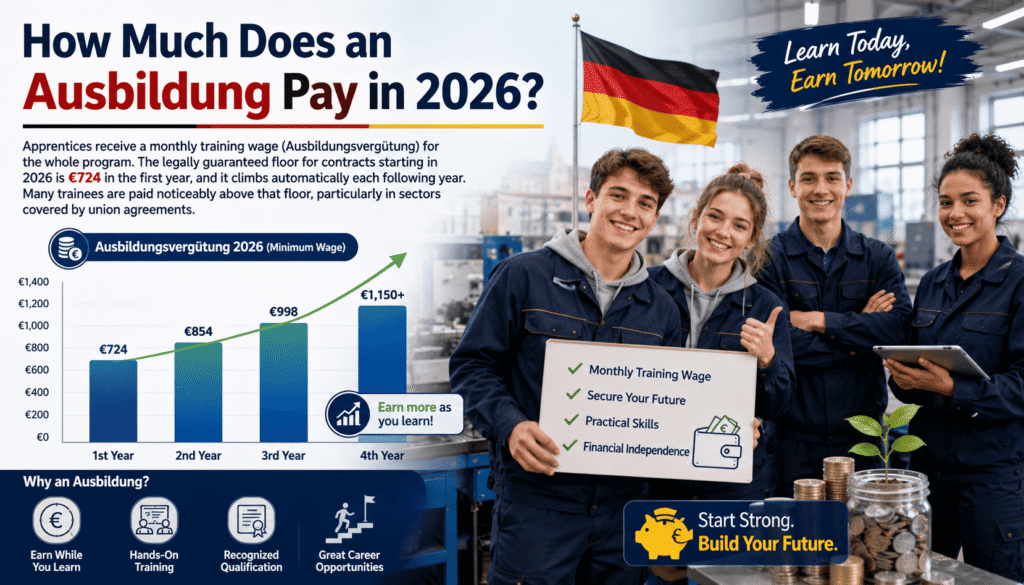
Statutory Minimum Training Wage for 2026:
| Training Year | Minimum Monthly Pay (2026) |
|---|---|
| Year 1 | €724 |
| Year 2 | €854 |
| Year 3 | €977 |
| Year 4 | €1,014 |
A few things worth knowing about pay:
- This table shows the legal minimum, not the typical figure. Apprentices working under a collective bargaining agreement earned an average close to €1,133 gross per month across all four training years back in 2024, according to BIBB data.
- Sector makes a real difference. Nursing apprentices, for instance, commonly start closer to €1,340–1,490 a month under healthcare-sector agreements, while IT trainees more often land in the €1,000–1,200 range. Treat exact figures as ballpark — the real number depends on your employer, region, and any applicable tariff agreement.
- Wages step up automatically each training year and can never legally dip below the federal minimum, regardless of whether a union contract applies.
Who Can Start an Ausbildung?
There’s no single federal entry requirement — individual employers decide who they hire — but most positions want applicants who’ve completed at least a Hauptschulabschluss or Realschulabschluss (Germany’s lower or intermediate school-leaving certificates). Competitive fields like IT or banking often lean toward candidates with an Abitur. International applicants typically need German at a B1–B2 level, plus a visa if they’re coming from outside the EU.
Broadly, most programs expect:
- A finished German school qualification, or a recognized equivalent from abroad
- Working knowledge of German, since Berufsschule lessons are taught in German
- A solid application and interview showing genuine motivation
- For certain trades, a passed aptitude test or a trial workday (Probearbeiten)
- For applicants from outside the EU, a valid residence permit or visa specifically for vocational training
There’s usually no hard age cutoff either — plenty of people start an Ausbildung as a career switch or after already finishing a degree.
How to Apply for an Ausbildung Step by Step
The general path looks like this: pick a profession, prepare an application (CV, cover letter, school records), apply directly to individual companies, go through interviews or a trial day, sign the training contract, and get registered with the local Chamber. Most application windows for a September start open six to twelve months ahead of time.
Here’s the process broken down:
- Pick a trade that fits your interests, and check its exact entry requirements and training content.
- Find open positions through job boards like the Bundesagentur für Arbeit, company career pages, or Chamber apprenticeship listings.
- Put together your application: a German-format CV (Lebenslauf), a tailored cover letter (Anschreiben), and copies of school certificates.
- Apply straight to employers — unlike university admissions, there’s no central body handling Ausbildung placements.
- Go through interviews or assessment days, which sometimes include an aptitude test or a hands-on trial shift.
- Sign the contract once you’re accepted — the company then registers you with the relevant Chamber.
- Begin training, most commonly in August or September, though some trades start throughout the year.
Can International Students and Foreigners Do an Ausbildung?
Yes — non-EU citizens are welcome to apply, but they generally need a national visa for vocational training, German proficiency (usually at least B1), and a signed training contract from a German employer before that visa can be issued. EU and EEA citizens can simply move and start without a visa requirement.
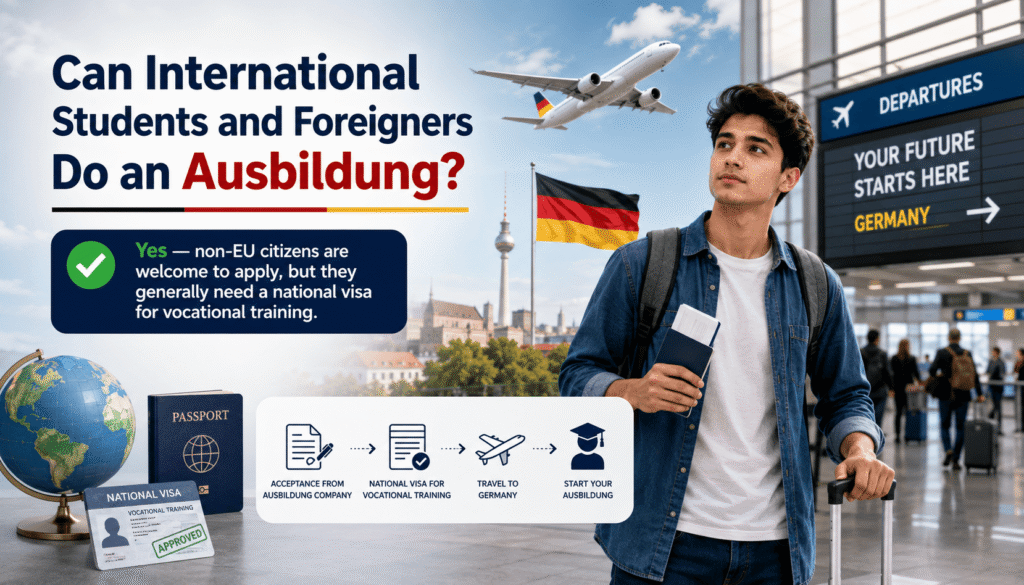
Points that matter most for applicants coming from abroad:
- Most employers and vocational schools require proof of German ability, usually a B1 or B2 certificate, since classroom instruction happens in German.
- Non-EU nationals typically apply for a national (Type D) visa for vocational training purposes at their local German embassy or consulate, using the signed training contract as supporting evidence.
- Once accepted, apprentices can usually work part-time on top of their training and may be eligible to extend their residence permit to look for a job after finishing.
- Some sectors with skilled-labor shortages, healthcare in particular, actively recruit trainees from abroad and sometimes provide extra support with language courses or relocation logistics.
If your German isn’t quite at that level yet, or you’d rather study before committing to a trade, it’s worth reading about options to study in Germany in English for free, which can be a useful stepping stone before or alongside an Ausbildung.
Ausbildung or University — Which Path Makes More Sense?
Neither path beats the other outright. Ausbildung gets you into paid, stable work faster and skips tuition fees entirely, while university builds the kind of academic credential often needed for research, management track roles, or licensed professions. A lot of Germans pick Ausbildung specifically because it lets them earn a wage and a qualification at the same time, with zero student debt.
| Factor | Ausbildung | University |
|---|---|---|
| Duration | 2–3.5 years | 3–6+ years |
| Cost | Free, and you’re paid a wage | Low/no tuition, but typically no salary unless you work separately |
| Focus | Practical, trade-specific skills | Broader academic and theoretical knowledge |
| Outcome | Certified profession, quick job entry | Academic degree, wider range of career directions |
| Growth path | Meister, Techniker, or further study later | Specialist, management, or research-track roles |
It’s also increasingly common to blend the two rather than pick one — either finishing an Ausbildung and studying afterward, or enrolling in a dual study program (duales Studium) that combines a full bachelor’s degree with structured company training from day one.
What Comes After You Finish an Ausbildung?
Once you clear the final Chamber exam, you walk away with a professional certificate recognized across the country. Most training companies extend an offer to keep you on permanently, though you’re free to look elsewhere too. From there, many people go on to earn a Meister or Fachwirt qualification, and some eventually move into university study.
Typical next steps after graduating:
- Staying on with the company: Many employers offer a permanent contract (Übernahme) to trainees who’ve performed well, especially in trades facing labor shortages.
- Advancing further: Qualifications like Meister, Fachwirt, or Techniker open the door to supervisory, managerial, or self-employed roles.
- Moving into higher education: A completed Ausbildung can also count as an entry route into certain university programs, even without a traditional Abitur.
- Pay increases over time: Starting salaries after Ausbildung are typically well above the training wage, and continue growing with experience or extra certifications.
Frequently Asked Questions
What does “Ausbildung” translate to in English?
It literally means “training” or “education,” but in a career context it refers to a paid, formally regulated apprenticeship that mixes company-based work with vocational schooling.
How long does it take to complete an Ausbildung?
Most programs take between 2 and 3.5 years, depending on the trade, and can sometimes be shortened for applicants who already have strong qualifications.
Do apprentices actually get paid?
Yes. It’s paid work from day one. Contracts starting in 2026 must pay at least €724 a month in the first year, with mandatory increases each following year — though many trainees earn more depending on their trade and region.
Are non-Germans allowed to do an Ausbildung?
Yes. International applicants, including those from outside the EU, are eligible. Non-EU applicants generally need a signed training contract plus a national visa for vocational training, along with sufficient German language skills.
Is Ausbildung the same thing as an internship?
No. An internship (Praktikum) is usually short-term and doesn’t lead to a formal qualification. Ausbildung runs for multiple years and ends in a nationally recognized certificate.
What do I need to qualify for an Ausbildung place?
Requirements shift by employer and trade, but most expect a completed secondary school certificate, and international applicants usually need German at around B1 level or higher.
Is Ausbildung a better choice than university?
It comes down to your goals. Ausbildung gets you into paid, skilled work faster without tuition costs, while university fits careers that require an academic degree. Plenty of people end up combining both over the course of their career.
What if I don’t pass the final Ausbildung exam?
You can generally retake it, sometimes after extending your training period a bit, following the process set out by your responsible Chamber (IHK or HWK).
Conclusion
Ausbildung remains one of the clearest, most practical ways to build a skilled career in Germany — you earn a wage from the start, avoid tuition debt, and finish with a qualification that employers across the country actually recognize. Whether you’re a German school leaver choosing between an apprenticeship and university, or an international applicant weighing your options, the dual system offers a structured, well-supported path into stable, in-demand work. If you’re still deciding between routes, it’s worth also looking into dual study programs or ways to study in Germany in English for free — both can work alongside or as an alternative to a traditional Ausbildung, depending on your goals and current German level
About the Author





10 thoughts on “Ausbildung in Germany Explained: 7 Essential Facts for 2026”