Scholarships in Germany Promotional Graphic-compressed
Paying for university involves more than tuition. Rent, groceries, transport, health insurance and learning materials can strain a budget, even at public universities with relatively low study costs. Fortunately, scholarships in Germany may help students manage these expenses while developing academic and professional skills.
This guide explains scholarships in Germany for German citizens, international students already living in the country, refugees with qualifying circumstances, and applicants planning to move abroad for their studies. It covers DAAD, Deutschlandstipendium, foundations, university support, doctoral funding and financial aid that is sometimes confused with scholarships.
Why Scholarships in Germany Matter
Funding can help cover monthly living expenses, study-related travel, research materials or selected tuition charges. Some awards also provide mentoring and professional networks. However, scholarships in Germany differ considerably: an award described as fully funded may still exclude particular costs.
Types of Scholarships in Germany

Merit-based awards consider academic achievements and potential. Need-sensitive programmes may consider household finances or difficult personal circumstances. Foundation scholarships often assess civic engagement and alignment with an organisation’s aims. Research grants support doctoral or specialist projects.
Fully funded scholarships in Germany may provide substantial living support, but not necessarily every expense. Partial awards may contribute a fixed amount or reduce tuition. A tuition discount, research salary and government student benefit are not interchangeable with a scholarship.
DAAD Scholarships in Germany
The German Academic Exchange Service (DAAD) runs numerous academic exchange and funding programmes. Many target international graduates, doctoral researchers and academics. Other DAAD initiatives support eligible students and researchers based in Germany who wish to study or research abroad.
DAAD scholarships in Germany have programme-specific rules. Academic level, nationality, degree completion date, experience and language qualifications can affect eligibility. Applicants may need transcripts, references, a motivation letter or a research proposal.
Financial benefits vary, potentially including stipends, travel contributions and insurance support. Search the official DAAD scholarship database rather than relying on an old summary of award amounts.
DAAD EPOS
The EPOS programme funds eligible applicants undertaking selected development-related postgraduate courses. Relevant professional experience, commonly at least two years, is generally expected alongside course requirements. It is not a general undergraduate scholarship.
Read AusbildungWay’s DAAD EPOS scholarship guide to understand the pathway before checking the latest programme announcement.
Deutschlandstipendium for Enrolled Students
Deutschlandstipendium is one of the most accessible scholarships in Germany to investigate if you already attend, or are preparing to join, a participating university. It offers eligible recipients €300 each month, jointly financed by government and private sponsors.
German citizens and international students may apply, subject to their university’s rules. Selection can consider grades, volunteering, achievements and challenging personal circumstances. Universities manage applications and deadlines locally; there is no single application that automatically covers every institution.
Importantly, Deutschlandstipendium is generally compatible with BAföG. Check your university’s scholarship office and the official Deutschlandstipendium programme for current details.
Heinrich Böll Foundation Scholarships
The Heinrich Böll Foundation supports academically capable and socially committed students and doctoral candidates. Its selection process values engagement with issues such as democracy, human rights and environmental sustainability.
Among scholarships in Germany, this foundation has particularly important distinctions between applicant groups. German citizens and certain applicants educated in Germany may have access to different study levels from international applicants who obtained entrance qualifications abroad. German-language ability is also significant.
Review the official foundation application guidance before drafting a motivation statement.
SBW Berlin Scholarship
SBW Berlin offers specific scholarship pathways connected to social commitment. Its international-student programme considers applicants’ participation in community projects, and a separate refugee-oriented pathway has its own eligibility conditions.
When assessing scholarships in Germany, read SBW Berlin’s contract especially carefully. Depending on the scheme, assistance may involve accommodation and living support, but repayment provisions can apply under certain circumstances, including remaining in Germany after an international scholarship ends.
The programme should therefore not automatically be described as unconditional, fully free funding. Consult the SBW Berlin official scholarship overview for its current conditions, eligible groups and application steps.
IU Germany Scholarships and Discounts
IU International University of Applied Sciences advertises selected scholarships and tuition-related offers. Availability depends on the study model, individual programme and current terms.
Students comparing scholarships in Germany must distinguish a competitive scholarship from a tuition discount. Neither automatically covers rent, food or insurance.
Scholarships for Students Already Living in Germany
Germany-based students do not necessarily need to apply through international recruitment programmes. Participating universities, foundations and regional organisations can offer opportunities to people already enrolled locally.
University scholarship pages, International Offices and student advisory centres are useful starting points. Some institutions offer completion grants or short-term emergency assistance, although these are not necessarily conventional scholarships in Germany.
German citizens may also investigate BAföG, while certain foreign nationals and refugees can qualify depending on their specific residence circumstances. Simply living in Germany or holding a study residence permit does not establish eligibility for every funding scheme.
BAföG Versus Scholarships in Germany
BAföG provides statutory educational assistance to eligible learners and is not a scholarship. Eligibility considers factors such as residence status, educational programme, age and relevant finances.
For university students, support typically combines a grant with an interest-free repayable share, subject to exceptions. Unlike many scholarships in Germany, BAföG primarily follows legal entitlement rules rather than competitive academic selection.
| Feature | BAföG | Scholarship |
|---|---|---|
| Basis | Statutory eligibility | Provider criteria |
| Funding | Financial assistance | Grant or other award |
| Repayment | Often partly repayable | Varies by agreement |
| Application | BAföG office | University or provider |
Consult official BAföG information for current rules. Some scholarship income can affect BAföG calculations, although Deutschlandstipendium is generally compatible.
Fully Funded PhD and Research Opportunities
PhD applicants may receive doctoral scholarships in Germany or secure paid research positions. Both can support research, but their legal and financial arrangements differ.
A stipend might not carry the same social-insurance treatment as employment. A paid university position generally has contractual duties and salary deductions. Compare supervision, project length, insurance, funding renewal and expected workload.
German and international candidates can explore the Research in Germany portal alongside university vacancies and DAAD opportunities.
Comparison: Which Funding Fits You?
| Programme | Potential audience | Key consideration |
|---|---|---|
| DAAD | Eligible graduates and researchers | Specific calls and eligibility |
| DAAD EPOS | Eligible postgraduate professionals | Work experience and selected courses |
| Deutschlandstipendium | Eligible university students | €300 monthly; local applications |
| Heinrich Böll | Eligible students and PhD candidates | Engagement and language criteria |
| SBW Berlin | Selected social-project applicants | Contractual obligations |
| IU | Eligible IU applicants | Scholarship versus discount |
| BAföG | Statutorily eligible learners | Not a scholarship |
| Research employment | PhD candidates | Salary rather than stipend |
The best scholarships in Germany depend on your education, academic record, residence situation and financial needs. There is no universal winner. For example, a bachelor student enrolled in Berlin might begin with Deutschlandstipendium, while an experienced development professional might check EPOS.
How to Apply for Scholarships in Germany
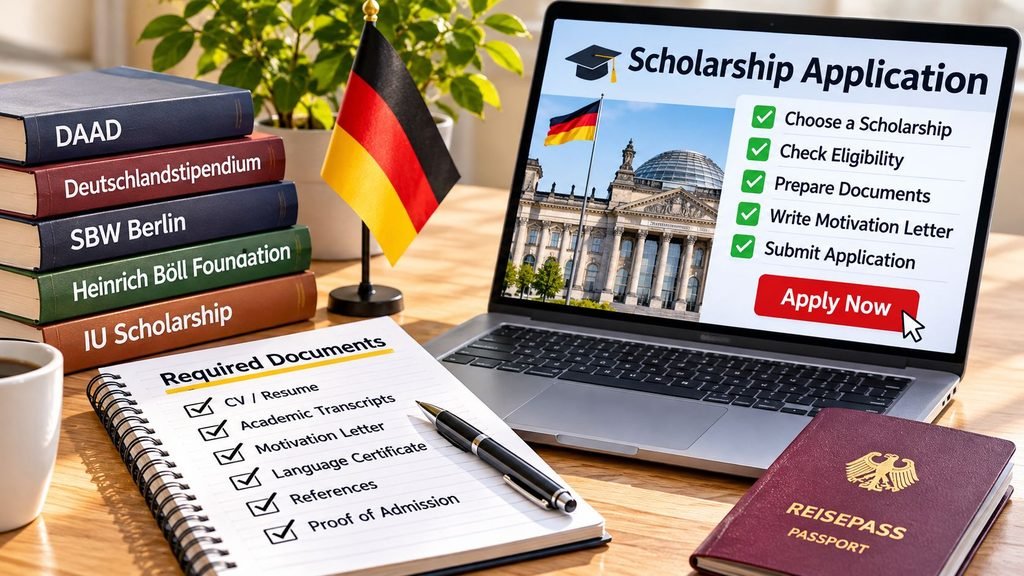
1. Identify your stage. Determine whether you need bachelor’s, master’s, doctoral or research funding. Shortlist programmes that actually cover your level.
2. Confirm eligibility. Check nationality, residence status, academic qualifications, language evidence, prior employment and university admission requirements.
3. Prepare documents. Typical materials include transcripts, a CV, motivation letter, references, language certificates and, where needed, a research or community-project proposal.
4. Explain your fit. A useful motivation letter connects your achievements to the particular programme. Give specific examples rather than generic statements about ambition.
5. Apply officially. Use the university or provider’s published platform. Keep copies of submissions and record confirmation messages.
6. Track decisions. Note deadlines, interview stages, funding periods and renewal requirements.
Living Costs, Insurance and Financial Proof

Even with scholarships in Germany, calculate a complete monthly budget. Include rent, utilities, food, transport, semester charges and health insurance. Your scholarship may not cover all these expenses.
For related information, visit AusbildungWay’s Finance category, including guidance on student banking and insurance.
An appropriate scholarship may sometimes serve as financial evidence in a student visa application, depending on amount, recognition and applicable rules. A partial tuition reduction alone usually cannot be assumed sufficient. Confirm requirements with the relevant German mission or immigration authority.
Ausbildung trainees should research separate support schemes such as Berufsausbildungsbeihilfe (BAB). These are not automatically the same as university scholarships in Germany.
Common Mistakes to Avoid
Applicants sometimes misunderstand a discount as full funding, overlook specific residence conditions, miss deadlines or submit incomplete documents. Others use a generic motivation letter or rely on unofficial agents promising guaranteed awards.
Read the official announcement, verify the organisation and review possible repayment clauses before accepting support. Never describe uncertain funding as guaranteed income.
Asked Frequently Questions about scholarships in Germany
Can German citizens apply for scholarships in Germany?
Yes. Deutschlandstipendium and certain foundation awards are open to eligible German students. Conditions vary by provider and study level.
Can international students already in Germany apply?
Yes. University awards and some foundations may accept eligible enrolled international students. Residence and educational history can matter.
Are scholarships in Germany always fully funded?
No. Benefits range from tuition reductions to monthly allowances and broader research packages. Verify actual coverage.
Is IELTS compulsory?
Not universally. The university and funding provider decide which language evidence they accept.
Can BAföG and Deutschlandstipendium be combined?
They are generally compatible, but check personal circumstances and any additional funding with the relevant office.
Can scholarships in Germany pay for Ausbildung?
University awards generally target degree students. Trainees should investigate BAB and occupation-specific support separately.
Can an award replace a blocked account?
Certain recognised scholarships may count toward visa financial proof, but this is assessed under the applicable immigration rules.
Conclusion
Finding suitable scholarships in Germany requires careful research, realistic expectations and thorough application preparation.
German citizens, international students already living in Germany and applicants planning to move there may have access to different funding pathways.
Deutschlandstipendium can support eligible university students, while DAAD offers a variety of academic exchange and research opportunities. Foundations such as Heinrich Böll and SBW Berlin have their own priorities and eligibility rules.
BAföG and paid doctoral research positions may also provide financial support, although they should not be confused with conventional scholarships.
Before applying, verify the official requirements, prepare accurate documents and compare the financial benefits and obligations of each programme.
For more helpful resources, visit AusbildungWay’s Finance section to explore student banking, financial planning and insurance information.
About the Author