daad epos scholarship
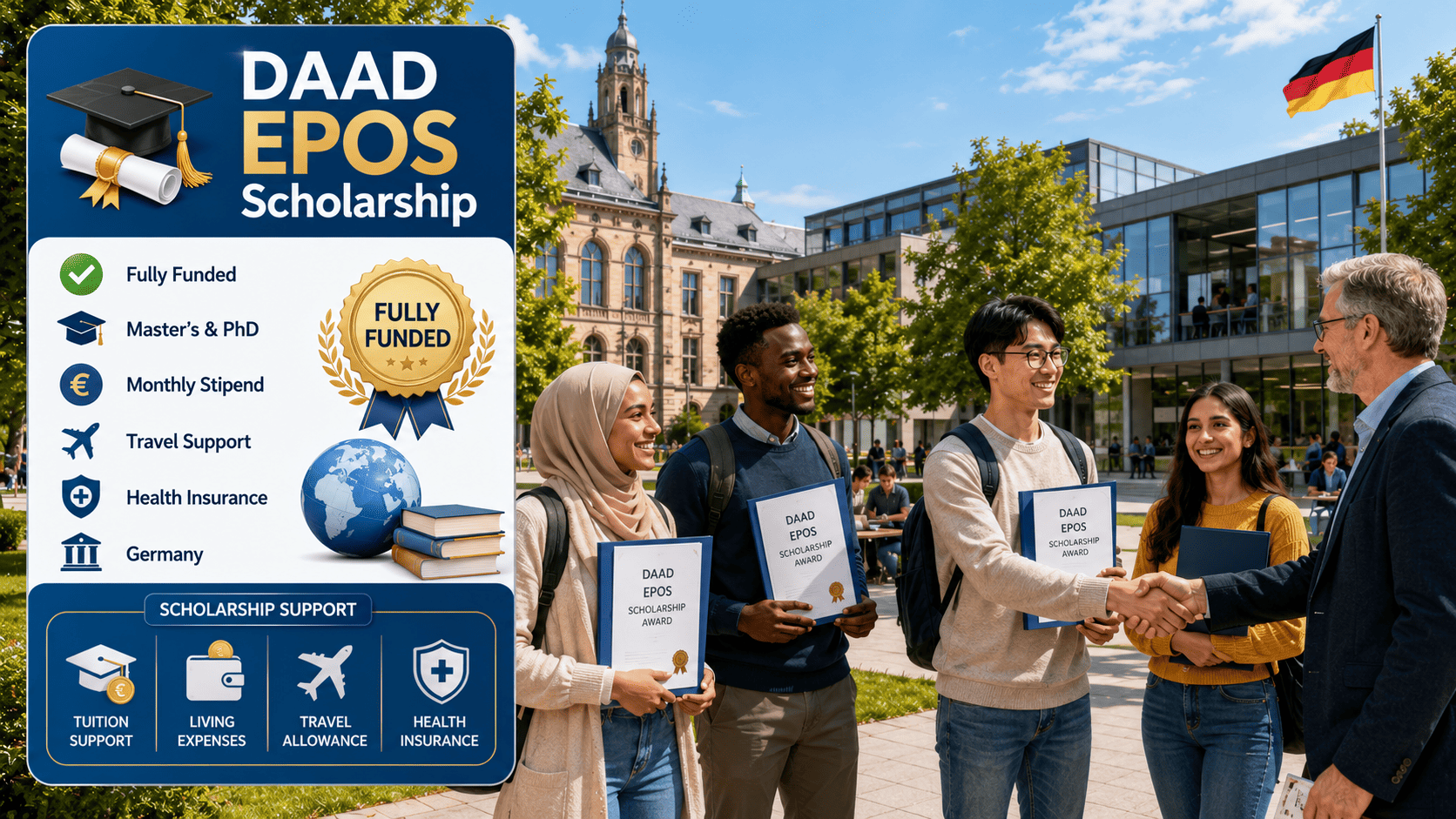
The DAAD EPOS scholarship is one of most trusted, fully routes funded for professionals from developing countries who want to study Master or PhD program in Germany. Short for Related Development Postgraduate Courses, DAAD EPOS scholarship is run by German Exchange Academic Service DAAD and has funded more than 7,000 students since it began in 1987. If you are researching DAAD EPOS scholarship for 2026/27 intake, this guide covers eligibility, stipend amounts, deadlines and steps exact to apply.
Quick Answer DAAD EPOS scholarship is funded fully German government scholarship for graduates from developing and newly industrialized countries who want to pursue development related Master’s or, in some cases, PhD program in Germany. It covers tuition, monthly stipend around €992 for Master’s and €1,300–€1,400 for PhD candidates, travel costs and health insurance. Applicants need relevant Bachelor’s degree and at least two years of professional experience.
What Is DAAD EPOS Scholarship ?
DAAD EPOS scholarship (European Postgraduate Studies / Development Related Postgraduate Courses) is designed for working professionals from developing and newly nations industrialized who want to gain an internationally recognized qualification and then return home to contribute to sustainable development. Unlike many general study grants, the DAAD EPOS scholarship is course specific it only applies to fixed list of development related postgraduate programs approved by DAAD each year, spanning fields like public health, engineering, planning urban, economics and environmental governance.
Because DAAD EPOS scholarship targets candidates who already have real world experience, it is considered one of more prestigious scholarship in Germany options for mid career professionals rather than fresh graduates. If you’re weighing your overall options to study abroad in Germany, DAAD EPOS route is worth comparing against other funding programs before you commit.
DAAD EPOS Scholarship 2026 Key Facts at Glance
| Detail | Information |
|---|---|
| Program Name | DAAD EPOS Scholarship (Development Related Postgraduate Courses) |
| Provider | German Academic Exchange Service DAAD |
| Degree Levels | Master’s, MBA, LLM, MPhil and exceptionally PhD |
| Duration | 12 42 months, depending on program |
| Monthly Stipend | ≈ €992 (Master’s) / €1,300–€1,400 PhD, from Feb 2026 |
| Coverage | Tuition, stipend, allowance travel, health insurance |
| Deadline | Varies by course most fall between mid 2025 and early 2026 for 2026/27 intake |
These figures make DAAD EPOS scholarship one of the strongest fully funded options when comparing it to the DAAD scholarship 2026 deadlines for other DAAD programs, since EPOS specifically rewards candidates with development-oriented career goals.
DAAD EPOS Scholarship Eligibility criteria
Before applying for DAAD EPOS scholarship, check that you meet these core requirements. DAAD reviews each application strictly, so missing one even criterion can disqualify an otherwise strong candidate.
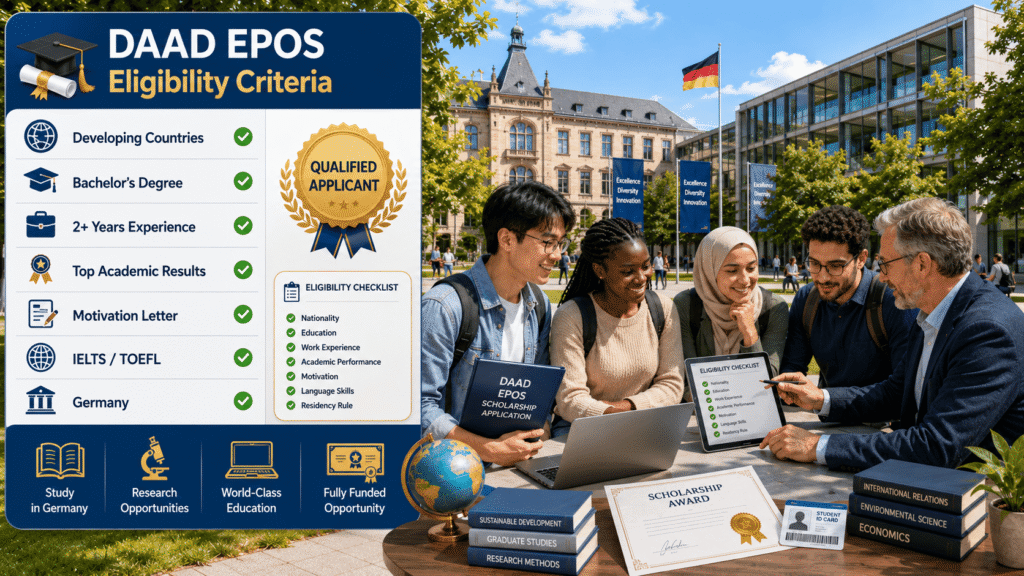
- Nationality: You must come from DAAD recognized developing or newly industrialized country.
- Academic Background: A Bachelor’s degree (usually four year program) in a relevant subject, normally completed within the last six years.
- Professional Experience: At least two years of relevant, full time work experience after your first degree this is non negotiable for the DAAD EPOS scholarship.
- Academic Performance: Results should be in upper third of your graduating class.
- Development Motivation: A clear written well motivation letter linking your studies to sustainable development in your home country.
- Language Proficiency: English or German test scores as required by your course chosen IELTS/TOEFL or TestDaF/DSH.
- Residency Rule: Applicants who have lived in Germany for more than 15 months before deadline are usually eligible not .
If you don’t yet meet professional experience requirement, consider vocational route such as an Ausbildung in Germany to build hands on experience first, then return to the DAAD EPOS scholarship once you qualify.
DAAD EPOS Scholarship Benefits And Stipend
One reason DAAD EPOS scholarship remains so competitive is depth of its financial package. Recipients don’t just get tuition waived they receive comprehensive support designed to remove financial barriers entirely.
- Monthly stipend of approximately €992 for Master’s students and €1,300 rising to €1,400 from February 2026 for PhD candidates
- Full tuition coverage at participating state recognized German universities
- Travel allowance to and from Germany
- Health, accident, and personal liability insurance
- In some cases, a rent subsidy and allowances for accompanying family members
- Optional German language courses before the program begins
Because DAAD EPOS scholarship is fully funded, it ranks consistently among most searched DAAD scholarships for international students, especially compared to funded partially alternatives. If tuition free study interests you more broadly, our guide on how to study in Germany in English for free explains other no pathways cost alongside DAAD funding.
DAAD EPOS scholarship 2026 deadline
There is no single, universal DAAD EPOS scholarship deadline each university participating and course sets its own date. For 2026/27 intake most deadlines between mid fall 2025 and early 2026, with few accepting programs applications as late October 2026 for 2027 start. Because DAAD EPOS scholarship works this way you must:
- Identify your course target in official DAAD EPOS course list.
- Note that course’s specific deadline not general DAAD date.
- Apply weeks several early, since documents and references take time to prepare.
Missing course specific deadline is most common reason candidates lose their chance at the DAAD EPOS scholarship each year so build personal timeline as soon as you shortlist programs.
How to apply for DAAD EPOS Scholarship
Applying for DAAD EPOS scholarship is different from directly applying to DAAD. Applications go through individual university or program, not through a central DAAD portal. Here’s the step by step process:
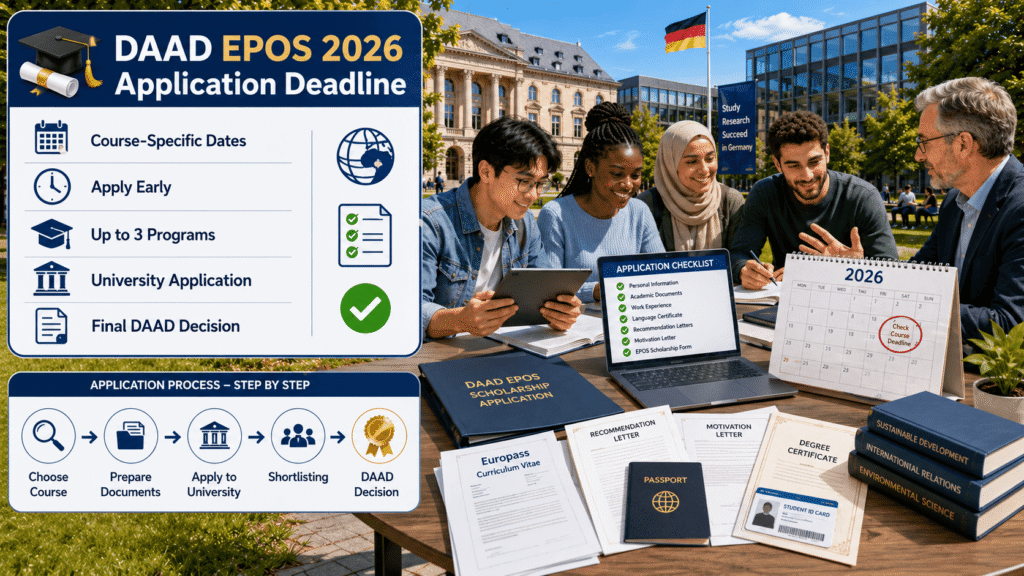
- Research eligible courses Browse official DAAD scholarship database and shortlist programs matching your field and career goals.
- Check eligibility per course: Each program may add its own requirements on top of general DAAD EPOS scholarship criteria.
- Gather documents: Academic transcripts, degree certificates, CV Europass format, proof of two years’ work experience, language certificates, two recommendation letters and motivation letter.
- Apply directly to the university: Submit your full application including the EPOS scholarship form to course provider, not to DAAD headquarters.
- Rank your choices: You may apply to up to three EPOS courses list them in consistent order of preference across all forms.
- Wait for shortlisting: The university applications reviews and forwards shortlisted candidates to DAAD.
- Final DAAD decision: DAAD makes final scholarship award and successful notifies applicants.
Since public universities dominate DAAD EPOS scholarship course list, it also helps to understand how wider system works see our overview of public universities in Germany for context on tuition, structure, and recognition.
Fields Covered by DAAD EPOS Scholarship
The DAAD EPOS scholarship funds defined list of development related postgraduate courses, commonly including:
- Public health and health international management
- Environmental governance and resource sustainable management
- Urban planning and regional development
- Engineering renewable energy, water management, infrastructure
- Economics, public policy and development cooperation
- Agricultural sciences and food security
Some universities also structure related coursework around Germany’s applied-learning model if that interests you, read about dual study in Germany to see how learning classroom combines with practical training.
Documents Checklist for DAAD EPOS Scholarship
A share large of rejected applications fail on paperwork rather than eligibility. Before you submit your DAAD EPOS scholarship application, confirm you have every below item, formatted exactly as your target course requests:
- Completed DAAD EPOS application form typed, not handwritten
- Certified copies of your Bachelor’s degree certificate and transcripts
- Europass format CV with no unexplained employment gaps
- Work certificate(s) confirming at least two years of professional relevant experience, with exact employment dates
- Motivation letter connecting your studies to development goals in your country home
- Two academic or professional letters of recommendation
- Language proficiency proof (IELTS/TOEFL for English taught courses or TestDaF/DSH for German taught courses)
- Passport copy and passport style photo
Universities reviewing the DAAD EPOS scholarship typically shortlist reject incomplete files automatically, so double-check specific course page for any additional documents before you submit.
DAAD EPOS Scholarship vs Other DAAD Scholarships:
DAAD several runs funding programs, and it’s easy to confuse them. The DAAD EPOS scholarship stands apart because it is tied to fixed list of development related courses and proven requires professional experience, whereas some general DAAD scholarships for international students in Germany are open to fresh graduates with no work history. Programs like DAAD RISE scholarship target undergraduate research interns, while broader DAAD Master’s or doctoral grants may not require a development focused motivation letter at all. If your profile fits experience and development criteria, DAAD EPOS scholarship is usually the stronger financial package, since it bundles tuition, monthly stipend, travel and insurance into one comprehensive award rather than partial funding.
It’s also worth comparing this route against Germany’s non university pathways. For candidates who are building still two years of experience DAAD EPOS scholarship requires, reviewing how higher German education is structured overall including public universities in Germany and practical training options can help you plan right timeline before applying.
DAAD Scholarship FAQS:
What is DAAD EPOS scholarship ?
The DAAD EPOS scholarship is fully funded German government program that supports experienced professionals from developing countries in completing development related Master’s or PhD in Germany.
How can I get DAAD EPOS scholarship ?
To get DAAD EPOS scholarship, choose an eligible course from official DAAD EPOS list, confirm you meet the two years experience and academic requirements, prepare strong motivation letter and apply directly to the university before its specific deadline.
How hard is it to get DAAD EPOS scholarship ?
The DAAD EPOS scholarship is competitive but not impossible success depends less on perfect grades and more on a clear development focused motivation letter, relevant work experience and choosing course that genuinely fits your background.
How does DAAD scholarship work ?
You apply directly to participating university’s development related course, the university shortlists candidates and DAAD then reviews shortlisted applicants and makes final scholarship award.
Is DAAD EPOS scholarship prestigious ?
Yes, With 90%+ completion rate among recipients and over 7,000 scholarships awarded since 1987, DAAD EPOS scholarship is regarded as one of Germany’s most funding respected programs for development focused professionals.
When does DAAD scholarship open ?
Application windows differ by course most open roughly year before the program starts, so always check your specific course page rather than general opening date.
How many DAAD EPOS scholarships are awarded each year ?
The exact number annually varies based on funding from Germany’s Federal Ministry for Economic Cooperation and Development BMZ, but program has supported more than 7,000 students in total since it launched.
Final Thoughts on DAAD Scholarship
The DAAD EPOS scholarship remains one of strongest fully funded paths to postgraduate study in Germany for professionals who already have field experience and genuine interest in development work. Success comes down to three things: picking right course from the official list, meeting eligibility criteria precisely and submitting complete application well before your course’s deadline. Start by exploring current DAAD EPOS course catalogue, then build your application timeline around it earlier you prepare, stronger your DAAD scholarship application will be.
About the Author






1 thought on “DAAD EPOS Scholarship 2026/2027: Complete Guide to Eligibility, Benefits & Application”