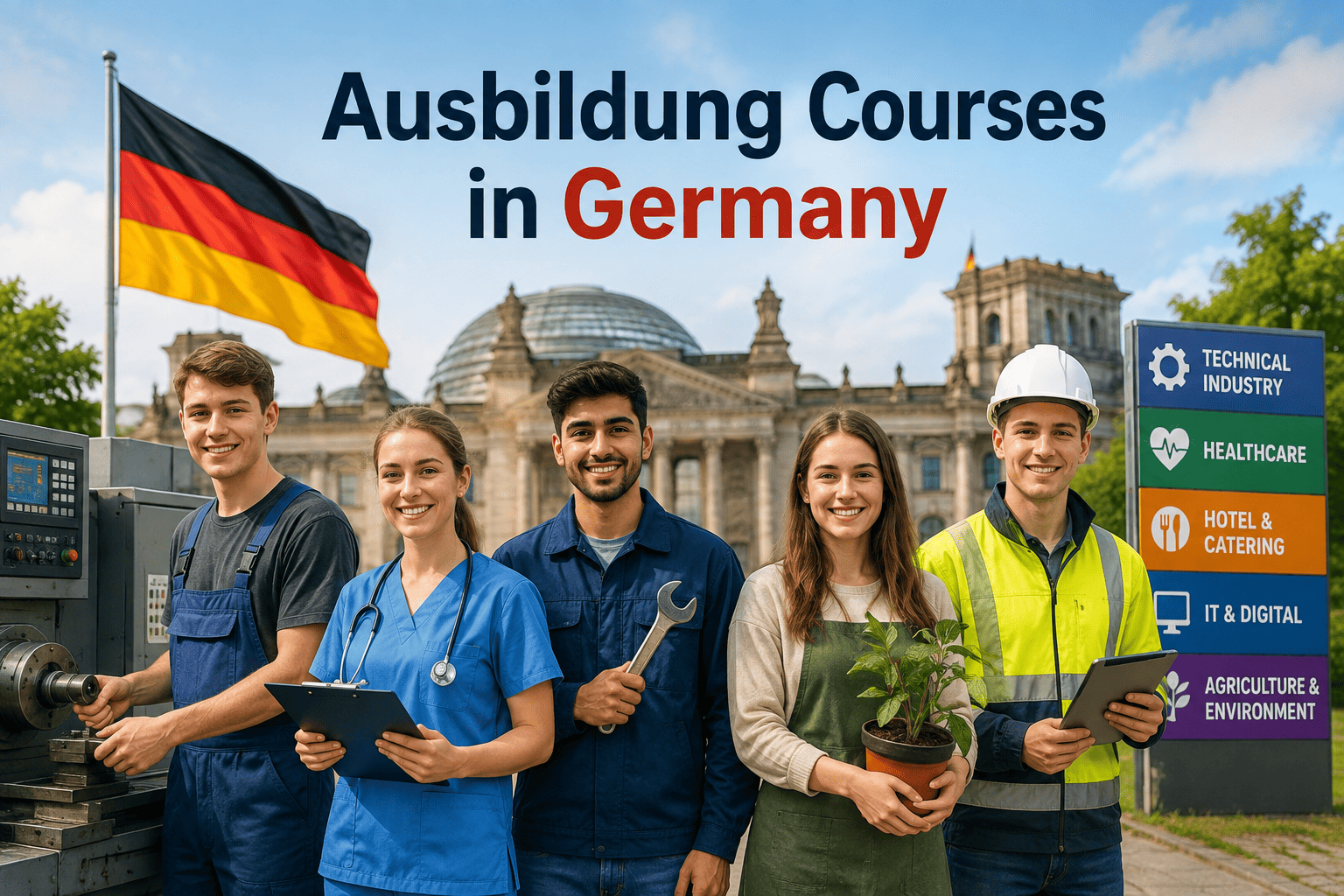
AUSBILDUNG COURSES IN GERMANY
Ausbildung courses in Germany offer paid, hands on path to a stable career. You learn on job. You earn stipend while training. And you graduate with a recognized qualification. This guide covers full list of ausbildung courses in Germany, how much they pay, which ones run in English and how international students can apply for 2026.
Quick Answer Ausbildung courses in Germany are dual training vocational programs lasting 2 to 3.5 years. They combine 70% on job work with 30% classroom study. There are more than 350 recognized occupations, covering healthcare, iT, engineering, hospitality and business. Trainees earn monthly stipend of €800 to €1200 and most programs require B1 or B2 German.
What Are Ausbildung Courses in Germany ?
Ausbildung courses in Germany are part of the country’s dual vocational training system. “Dual” means two things happen at once. You work at a real company. You also attend vocational school (Berufsschule) part time. This blend gives you practical skills and real income from day one. If you’re still comparing this path to a degree, see our guide on what Ausbildung in Germany actually means.
Germany Ausbildung courses exist because country faces real skills shortage. Germany need workers skilled in healthcare, technology and trades. This is why government keeps these programs affordable and often tuition completely free.
Ausbildung Courses in Germany 2026 Key Facts
| detail | information |
|---|---|
| duration | 2 to 3.5 years |
| structure | 70% on job training, 30% vocational school |
| Total occupations | 350+ fields recognized |
| Monthly stipend | €800–€1200 varies by field and year |
| Language requirement | B1–B2 German most programs |
| Employment rate | Around 92% after graduation |
| Starting salary | €2000–€3500/month post-training |
Full List of Ausbildung Courses in Germany
Here is the ausbildung courses in germany list covering the fields with the strongest demand. This ausbildung courses list in germany is starting good point if you’re not sure which direction to choose:
- Healthcare and Nursing: Pflegefachkraft nursing, careelderly, physiotherapy assistant
- Information Technology: iT specialist, software developer, network administrator
- Engineering and Technical trades Mechatronics, mechanic industrial, electrician, technician automotive
- Hospitality and Tourism Hotel management, service restaurant, assistant tourism
- Business and Administration: Office management, sales retail, logistics coordinator
- Design and Creative Fields: Graphic design, childcare Erzieher, media technology
This is from far every option. When people search for all ausbildung courses in germany, they’re often surprised to learn real number sits above 350 recognized occupations every across sector of the economy.
Ausbildung Courses in Germany for Indian Students
Ausbildung courses in Germany for Indian students have fast grown in recent years. Germany population aging and skills gap create steady openings. Here what Indian applicants typically need:
- Completed Class 12 or equivalent from recognized board
- Minimum age of 17 or 18, depending on program
- B1 German for English track roles, B2 for most German taught programs
- A signed training contract Ausbildungsvertrag before applying for visa
Healthcare and nursing remain strongest fit for many Indian applicants, since demand is high and rates placement run close to 98% in some regions. If you’re at this stage, our Germany Ausbildung visa guide walks through exact visa requirements once your training contract is signed.
Ausbildung Courses in Germany in English
A common question are there ausbildung courses in germany in english ? The honest answer is some, but not many. Most training happens in German, since colleagues, trainers and vocational school lessons all use language daily. That said, a growing number of English-friendly options exist:
- IT and software development roles at multinational companies
- Certain engineering placements inside international firms
- A small growing but set of digital media and logistics programs aimed at non EU applicants
Even in these English friendly roles, employers usually still expect B1 German, since Berufsschule portion is almost taught entirely in German. If full English matters instruction most to you, it may be worth comparing this path against university programs where you can study in Germany in English for free instead.
Hotel Management Ausbildung in Germany
Hotel management ausbildung in germany is one of the most popular choices among hospitality-focused applicants. Germany’s strong tourism industry — from Bavaria to Berlin — creates steady demand for trained staff. A typical hotel management Ausbildung covers:

- Front desk operations and guest services
- Housekeeping and facility management
- Event and banquet coordination
- Basic accounting and hotel software systems
Graduates move often into supervisory roles within few years, especially in cities with large hotel chains and conference centers.
Best Ausbildung Courses In Germany for 2026
Some fields simply offer stronger pay, faster placement, and better long-term prospects. Based on current demand, here are the best ausbildung courses in germany right now:
- Nursing Pflegefachkraft: Highest placement rate, strong post training salaries around €2800–€3200/month
- IT Specialist: Fast growing field with strong English language opportunities
- Mechatronics: High demand in Germany automotive and sectors manufacturing
- Electrician: Consistent shortage nearly across every German region
- Hotel Management: Reliable demand tied to steady tourism growth
These german ausbildung courses combine strong job security with solid starting pay, making them a safer bet for international applicants weighing multiple options.
How to Apply for Ausbildung Courses in Germany
Applying for ausbildung in germany courses follows a clear sequence:
- Choose your field Match your interests and qualifications to recognized occupation.
- Build Your German level aim for B1 at minimum, ideally b2, before applying.
- Search for opening: use official portals job, company career pages and Chamber IHK/HWK listings.
- Apply and interview: Many companies now interview online for international candidates.
- Sign your training contract: This document is required before you can apply for your visa.
- Apply for your visa: Review our full breakdown of student visa for Germany requirements for the general document process, since Ausbildung and student visas share several steps.
Once approved, most applicants can also compare their new city’s living costs using our cost of living in Germany guide before arrival.
Cost of Ausbildung Courses in Germany
One of the biggest reasons applicants choose ausbildung courses in germany over a traditional degree is the cost. Most company-based programs charge zero tuition. Instead of paying fees, trainees earn monthly stipend throughout program. Few points worth knowing:
- Company-based programs: Almost always free, since the employer funds your training
- School-based programs: Common in nursing, physiotherapy, and childcare — usually free at public institutions, though some private schools charge fees
- Living costs: Budget €700–€1,200/month for rent, food, and insurance depending on the city
- Health insurance: Often partly subsidized for apprentices, typically €120–€160/month
This combination — paid training plus low living costs in smaller cities — is why so many international students see ausbildung courses in germany as a smarter financial choice than studying abroad in countries with high tuition fees.
Ausbildung Courses in Germany vs University Study
It worth comparing this path against university degree before deciding. Ausbildung courses in germany focus on practical, job ready skills. university degree focuses more on theory and research. Here simple breakdown:
- Ausbildung: Paid from day one, faster entry into workforce, narrower specialization
- University: Longer timeline, academic broader knowledge, higher long term earning potential in some fields
Some students both blend worlds through dual study program, which combines learning classroom with structured company placements. Our guide on dual study in Germany how explains that hybrid path works. If you’re still weighing full degree instead, our overview of public universities in Germany covers traditional academic route in detail.
Documents Needed for Ausbildung Courses in Germany
Before you can start any of ausbildung courses in germany covered in this guide gather these documents early:
- School leaving certificate Class 10 or 12, depending on program
- German language certificate B1 or B2, based on field
- Updated CV in Europass format
- Motivation letter explaining your interest in the trade
- Signed training contract from your employer
- Valid passport for visa applications
Preparing these documents early speeds up both your training placement and your later visa application.
Career Growth After Ausbildung Courses in Germany
Finishing one of the ausbildung courses in germany doesn’t mean the journey stops there. Many graduates long build careers on top of their training:
- Direct employment: Around 92% of graduates job receive offers, often from same company that trained them
- Further specialization Meister: Skilled trades offer advanced Meister qualifications, supervisory unlocking and business owner roles
- Bridge to university: Some graduates later pursue related degree, using their practical training as strong foundation
- Permanent residency: Long term workers skilled with recognized qualifications often qualify for permanent residency after few years

This career flexibility is a major reason germany ausbildung courses attract so many international applicants each year — the training itself is only the starting point, not the ceiling.
Regional Availability of Ausbildung Courses in Germany
Not every region offers the same mix of ausbildung courses in germany. Larger cities like Berlin, munich and Frankfurt tend to have more openings in iT, business and hospitality. Smaller towns and rural regions often have demand stronger and less competition in healthcare, trades skilled and manufacturing. Choosing smaller city can also lower mean living costs, which stretches your training stipend further during program.
Ausbildung Courses in Germany — Frequently Asked Questions
What are most common ausbildung courses in Germany ?
Most common ausbildung courses in germany are nursing, IT specialist, mechatronics, electrician and hotel management.
Are there ausbildung courses in Germany in English?
Limited number of IT, engineering and logistics roles offer English friendly training, but most vocational school lessons remain in German.
What is required for ausbildung courses in Germany for Indian students?
Indian applicants typically need Class 12 completion, B1–B2 German, and a signed training contract before applying for their visa.
How long do ausbildung courses in Germany take?
Most programs run 2 to 3.5 years, depending on the occupation and training company.
Which are the best ausbildung courses in Germany right now?
Nursing, IT, mechatronics, electrician training, and hotel management currently offer the strongest demand and pay.
Final Thoughts on Ausbildung Courses in Germany
Ausbildung courses in Germany remain one of most practical, routes affordable into stable European career. With over 350 recognized fields, paid stipend and strong job placement rates, this path suits students who want work real experience alongside their training. Whether you’re drawn to healthcare, technology or hospitality, right germany ausbildung courses can open long term career path often without the tuition costs of traditional degree.
About the Author



2 thoughts on “Ausbildung Courses in Germany 2026: Complete List & Guide”