
NURSING AUSBILDUNG IN GERMANY FOR FOREIGNERS
Germany healthcare system is facing one of its biggest shortages staffing in decades, and that exactly why nursing Ausbildung in Germany for foreigners has become one of most searched pathways for people who want a stable, well-paid career in Europe without paying tuition university.
This guide everything covers step by step what the program actually is, who qualifies, how long it takes, language level you’ll need, which companies hire trainees foreign, where you’ll live during training, and how the program came to exist in its form current.
What Is Nursing Ausbildung in Germany for Foreigners?
Nursing Ausbildung in Germany for foreigners is fully paid, three year vocational training program that qualifies international candidates to become licensed Pflegefachfrau/Pflegefachmann (generalist nurse) while earning a monthly throughout salary their training.
Unlike a university nursing degree, this is a dual training model — trainees split their time between a nursing school (classroom theory) and a hospital, clinic, or care home (hands-on practical work).
Because it’s structured as an apprenticeship rather than a degree, nursing Ausbildung in Germany for foreigners doesn’t require existing academic credentials beyond a recognized secondary school certificate, which makes it accessible to a much wider group of applicants than a traditional nursing degree abroad.
Requirements for Nursing Ausbildung in Germany for Foreigners
Requirements for Nursing Ausbildung in Germany for Foreigners are recognized secondary school-leaving certificate, a minimum B1/B2 German language level, a clean criminal record, medical fitness, and a signed training contract with a German healthcare employer.
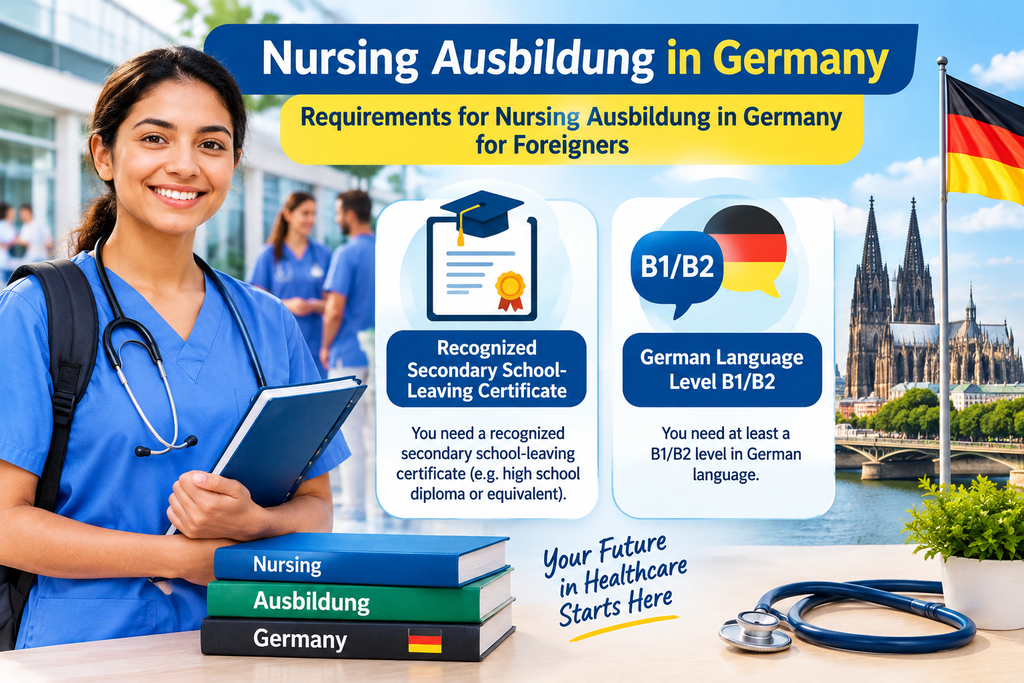
To qualify nursing Ausbildung in Germany for foreigners, applicants generally need to meet following:
- background Educational : secondary school leaving certificate equivalent to Germany Mittlerer Schulabschluss (usually 10 years of schooling)
- Age: No strict upper age limit in most federal states, though many programs prefer candidates under 35–40 for practical reasons
- Health certificate: Proof of physical and mental fitness for nursing work, including vaccination records
- Police clearance certificate: A clean criminal background check from your home country
- Signed Ausbildung contract: An offer from a hospital, care home, or clinic before applying for your visa
- Recognized German language certificate: Typically B1 at minimum, though many employers now prefer B2
Because the process combines educational and immigration both requirements, most successful applicants pursuing nursing Ausbildung in Germany for foreigners start preparing 6–12 months in advance before actually their training beginning.
Duration and Training Ratio of Nursing Ausbildung in Germany for Foreigners
Nursing Ausbildung in Germany for foreigners lasts exactly three years (36 months) and follows a structured ratio of roughly 2,100 hours of theoretical classroom instruction combined with around 2,500 hours of hands-on practical training.
This theory-to-practice ratio is intentional — trainees spend a little more time in real clinical settings than in the classroom, rotating through hospital wards, outpatient care, pediatric care, psychiatric care, and elderly nursing homes during their three years.
This rotational structure is one of the reasons nursing Ausbildung in Germany for foreigners produces such well-rounded, job-ready graduates by the time they finish, since they’ve already worked across multiple care environments before qualifying. In the final year, trainees can choose to specialize in either general adult care, pediatric nursing, or elderly care, or continue as a fully generalist nurse.
Language Requirements for Nursing Ausbildung in Germany for Foreigners
Most nursing schools and hospitals require at least a B1 German certificate to start training, and B2 level to sit the final licensing exam and work independently with patients.

Language ability is not just a formality bureaucratic here — nursing work involves communication constant with patients, doctors, and colleagues, so weak language skills can genuinely affect patient safety. Because of this, nursing Ausbildung in Germany for foreigners almost always requires of German proof proficiency through a recognized test such as Goethe-Institut exam, telc, or ÖSD before a visa is even issued. Some larger hospital groups also run in-house language intensive courses to help foreign recruits move from B1 to B2 during their first year of training.
Companies That Accept Foreign Nursing Trainees
major German healthcare employers Several actively recruit international candidates for nursing Ausbildung in Germany for foreigners, often supporting the visa process directly:
- Vivantes — One of Berlin’s largest hospital networks, well known for recruiting foreign nursing trainees and offering structured language support.
- Helios Kliniken — A nationwide hospital group with locations across Germany, frequently listing for Requirements for Nursing Ausbildung in Germany for Foreigners
- Fresenius Medical Care — A major healthcare and medical technology company that also trains nursing and medical technology apprentices.
- Asklepios Kliniken — A large private hospital group with an established international recruitment pipeline for nursing trainees.
- Caritas and Diakonie — Germany’s two largest church-affiliated welfare organizations, both heavily involved in elderly care and nursing training programs.
For a broader of employers comparison across different Ausbildung fields, not just nursing, see our full guide on best companies for Ausbildung in Germany.
Accommodation for Nursing Ausbildung in Germany for Foreigners
Many hospitals and care homes offer accommodation assistance to trainees nursing, ranging from staff dormitories to help finding a shared flat private near the workplace.
Because nursing shifts often start very early or run overnight, housing close to workplace is practical genuinely rather than just a bonus. Some larger hospital groups maintain their own staff specifically residences for trainees, while others help new arrivals connect with local landlords or listings shared-flat .
Since accommodation support is not guaranteed at every hospital, it’s worth confirming this directly with your employer before signing a contract training . For a full breakdown of housing types, costs and booking platforms across Germany, see our detailed guide on accommodation in Germany for international students.
When Start Nursing Ausbildung in Germany for Foreigners ?
The generalist nursing training current model was under Germany introduced Pflegeberufegesetz (Nursing Professions Act), which came into effect on January 1, 2020, previously merging three nursing separate qualifications into unified one program.
Before 2020 Germany trained nurses separately as nurses general, nurses pediatric or nurses elderly care , each with its own certification. The reform combined these into single generalist qualification to make nursing careers more flexible and to simplify recognition European Union across. This restructuring is also part of why nursing Ausbildung in Germany for foreigners has grown so quickly in popularity since 2020 — the unified qualification is recognized now more broadly across EU states member, giving international graduates far more career mobility after they training in Germany finish.
Salary During Nursing Ausbildung in Germany for Foreigners
Trainees in nursing Ausbildung in Germany for foreigners typically earn between €1190 and €1350 per month in first year, with pay increasing each year of three year program.

Unlike many countries where students nursing pay tuition and work jobs part time to cover living costs, nursing Ausbildung in Germany for foreigners is structured so trainees are paid a real wage monthly from day one, since they are legally classified as apprentices under a contract training rather than students.
By the third year, monthly pay rises generally to somewhere between €1,300 and €1,500, depending on employer, federal state and any applicable collective agreement bargaining. This steady income is one of biggest reasons the program appeals to international applicants compared to unpaid or tuition-based programs nursing elsewhere.
Growth Career After Completing Nursing Ausbildung in Germany for Foreigners
finishing After nursing Ausbildung in Germany for foreigners, graduates can work as fully licensed Pflegefachfrau/Pflegefachmann nurses, pursue further specializations or continue into university-level nursing management or programs education.
Graduates of nursing Ausbildung in Germany for foreigners are not limited to entry-level ward work forever — many go on to specialize in intensive care, care anesthesia, operating room nursing or psychiatric care through additional courses certification (Fachweiterbildungen) after a year or two of experience practical.
Asked Frequently Questions about nursing Ausbildung in Germany for foreigners
Q1: Who is eligible for nursing Ausbildung in Germany for foreigners? A: Anyone with recognized secondary school certificate, at least B1 German, a clean police record, and a signed training contract with a German healthcare employer can apply generally regardless of nationality.
Q2: How long does nursing Ausbildung in Germany for foreigners take to complete? A: The takes program exactly three years (36 months) full-time, combining classroom theory at a nursing school with rotational practical training across different hospital and settings care.
Q3: Do I need to already speak German to start nursing Ausbildung in Germany for foreigners? A: Yes, most programs require at least B1 level German before your visa is approved, with B2 typically needed by the time you take your final licensing exam.
Q4: Is nursing Ausbildung in Germany for foreigners paid during training? A: Yes, it’s a paid apprenticeship — trainees earn a monthly salary that increases each year of the three-year program, unlike university-based nursing degrees in many other countries.
Q5: Can I get a job in Germany after finishing nursing Ausbildung as a foreigner? A: Yes, graduates are offered typically a permanent contract with their training hospital and qualification also opens a path toward permanent residency due to Germany’s ongoing shortage nursing.
Q6: How much does nursing Ausbildung in Germany for foreigners pay in first year? First year trainees earn typically between €1190 and €1350 per month with exact amount depending on the employer and the federal state where training place takes.
Q7: Is nursing Ausbildung in Germany for foreigners open to candidates any country from? A: Yes, applicants from any country can apply, provided they meet language, education and health requirements and secure a signed contract training with a German employer before their application visa.
Conclusion
Nursing Ausbildung in Germany for foreigners offers practical genuinely route into a stable, in-demand career — paid training, no tuition fees and a nationally recognized qualification at end of three years. Between the structured theory-practice split, achievable requirements language and a long list of hospitals actively recruiting international trainees, it’s one of more pathways realistic for people serious about building a long-term life and career in Germany.
Applicants can also learn more about recognition procedures official through Germany’s Federal Recognition Portal, which explains how qualifications foreign and training pathways are assessed under German law. If you are planning this move, start early on your language certificate, accommodation confirm support with your chosen employer and make sure your training contract is signed before you begin visa process.
About the Author






1 thought on “Nursing Ausbildung in Germany for Foreigners (2026 Complete Guide)”